Showing posts with label Genre: Sci-Fi. Show all posts

Monday, 21 May 2012

Mawaru Penguindrum - Review


There are animes, there are art forms and then there is Kunihiko Ikuhara, the director of iconic magical girl animes Sailor Moon and Revolutionary Girl Utena. Evidently Ikuhara is well versed in cookie-cutter shows as well as breath-taking breaking the mould shows. So you’ll either get exactly what you want or exactly what you didn’t expect. Nevertheless both Sailor Moon and Revolutionary Girl Utena deal with a similar platform (not to mention virtually identical animation); Mawaru Penguindrum takes a fresh and entirely different approach. The concept is a little hard to pin down as the genre(s) is less shojo-romance and more mystery/comedy/sci-fi. And there are penguins. Lots of penguins.

The series centres on three siblings, twins Shouma and Kanba and their terminally ill younger sister, Himari. Initially Himari dies but is immediately reanimated into a penguin princess during one of the most spectacular magical girl transformations I’ve ever witnessed. The new and improved Himari demands a penguindrum in exchange for their sister’s new found health. What is a penguindrum? The princess doesn’t say, nor do we really find out until the very last episode and even then it’s still a little ambiguous.

The characters are all first rate. It’s near impossible to dislike any of them. Shouma and Kanba serve as superb protagonists, challenged with the heart-wrenching task of trying to save a loved one, a task that eventually leads them apart and seeking conflicting paths. Himari appears cute as a button one moment, than high-and-mighty princess the next, both roles are electrifying. One potential problem is the incest, fortunately that is resolved in the most satisfying conclusion, it’s not incest (major spoilers). Even Ringo, who is principally introduced as an annoying, single-minded stalker, has such stark revelations about her past, that the character is renovated into someone relatable and ultimately likable.

Mawaru Penguindrum is very much a character study in the sense that all of the primary cast have a rough upbringing and are in some way scarred, allowing for plenty of growth and development. One minor setback of the traumatic childhood is the over use of the lonely/abandoned child complex. This leads to great effect in some situations, namely the horrendous child broiler scenes which really work to drive home that there is something underlying evil with this society and not so much in others, chiefly the Masako storyline. Despite what I said early, this is one character that we didn’t get to see utilized to her full potential. She and her brother Mario were mostly padding for a shocking plot twist. Interesting enough, but perhaps not quite on par with the rest of the cast.

The storyline is impeccably well-crafted. From the outset, this is set up to be a tragedy. The beginning is (naturally) deceptive as the light-hearted, whimsical romantic-comedy element is gradually lost and replaced with a much colder ascetic. Mawaru Penguindrum is also a masterpiece of symbolism and surrealism that will certainly require several views in order to soak up all the references. Clearly nothing has been left to chance, or fate as is more relevant.

Mawaru Penguindrum is nothing short of magnificent. The sheer level of depth, of detail that has gone into the shows meticulous design is quite frankly staggering and the outcome is simply flawless. The devotion of the siblings as the core motivator is pretty powerful and the ending is incredibly satisfactory if a little open ended. Kunihiko Ikuhara is a true visionary and hopefully this will be the shape of more things to come from this wonderfully talented director.

Rating: 9/10
Recommended. 

Sunday, 29 April 2012

First Impression DC vs. Marvel


Young Justice Invasion 

It’s no secret that I’m not a DC girl. For me, DC tends to miss the mark more often than it hits it. The same is true for their animation. Aside from Batman the Animated Series which is sheer awesome and the comedic anime-styled Teen Titans, I’ve not given DC a second glance. I do remember watching Justice League, later Justice League Unlimited as a kid and being unimpressed with the level of corniness. Then along came Young Justice and it was finally a show that DC seemed to have the right balance of silliness and maturity. Despite a relatively young cast, the show was surprisingly dark (in comparison to other superhero shows comprising of teenagers – Teen Titans or X-Men Evolution for example). The original season was clever, concise and had plenty of character development. The second series is a different matter.

Season two is set five years after the events of the season one finale (which only aired last week). Not that this is made clear as to why, it’s only briefly referenced by Batman. So in the initial episode we learn that Kid Flash, Artemis, Red Arrow and Aqualad are no longer part of the team. Wow, I mean that could be quite a kick to the teeth to their fans. Zatanna and Rocket have also left but we still do see them briefly as members of the Justice League. Replacing them are Robin (Tim Drake), Blue Beetle, Beast Boy, Batgirl, Wonder Girl, Bumblebee and Lagoon Boy. Disappointingly none of these new characters actually makes an impression, their personalities pale in comparison to the original cast. Whereas season one gradually introduced its protagonists and even continued to expand up until the very end, season two completely jumps the shark by creating an entirely new line-up. Of course the biggest frustration is the break-up of Superboy and Miss Martian. During the original series their relationship was crucial to either character in order to gain stability and strength and ultimately to be able to accept themselves. It’s seems almost undignified that they should break-up off screen. Or that Miss Martian should be with Lagoon Boy (already top of the annoying list). I suppose the writers wanted the inevitable Superboy/Wonder Girl hook up to be less complicated.

In all, Young Justice: Invasion sure does have its work cut out. I mean in order to forgive tossing away five freaking years; it has to pull something beyond amazing out of its hat. I feel the need to explain to DC that fans get attached to characters. And fans don’t like change. We like characters with interesting personalities and experiences and we like watching them grow throughout the course of a series. We don’t like them being expendable or interchangeable.

Initial rating: 6/10


 The Avengers: Earth’s Mightiest Heroes.

Much like Young Justice, The Avengers had a killer first season with subtle hints towards an alien invasion in the next season. Unlike Young Justice, The Avengers is smart enough not to uproot its prior cast for an entire new one. Instead new characters/members are gradually introduced, notably Ms. Marvel, making her the second female to join the team, progress!

The second season spares no time in plunging the team into a new conflict with a new villain, none other than Dr. Doom. As well as introducing a new alliance, the Fantastic Four. The following episodes are primarily filler, exploring possible future story arcs, for example Maria Hill discusses superhero registration which would unavoidably lead into the notorious civil war scenario. The strength of The Avengers is in its awareness for what fans want to see. It doesn’t overload us with too many characters resulting in extended cameos, it takes its time to start on a smaller scale and build around the primary cast. This obviously allows certain characters – Iron Man for example more screen time, but more importantly is that it allows other characters the opportunity to develop within their own stories and solo adventures. For instance, Thor has not yet returned to Midgard, yet we have seen him and are aware a big bad Asgardian villain will pop up some time in the future. This is why I think Marvel has the upper hand as the creative staff seem to know less is sometimes more.

Initial Rating: 8/10 

Thursday, 26 April 2012

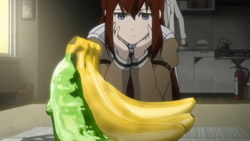
Steins;Gate Review


In terms of plot, Steins; Gate is a remarkable accomplishment. It handles an interesting premise with an original and thought-provoking manner. As a time-travel-theory novice I can’t vouch for the accuracy of the physics involved, nevertheless the context is pretty heavy-going, enough to indicate the writers have a vague idea over the subject matter. Or at least enough to make the utterly absurd sound plausible i.e. the microwave that sends text messages to the past. Unfortunately this is one of the few drawbacks, the overtly technical side. Understandably it can be a bit overwhelming especially in the beginning and factoring in the speed at which things progress, it’s not easy to digest initially. 

Steins; Gate takes it time to introduce the cast, the setting and the science, all done to the anime’s credit, before plummeting full throttle into a magnificent thriller that becomes the focal point. Despite a relatively repetitive sequence of events (literally), the storyline itself does not become repetitive. Quite the opposite actually, it becomes grippingly addictive. This is in no small part due to the unravelling of the complex, multi-layered plot and the fascinating exploration of trying to twist it back together.

For the most part, the characters are crafted wonderfully. Okarin as the primary protagonist and self-proclaimed mad scientist experiences the most character development largely down to the emotional roller-coaster he endures and thus is the most three dimensional. Whereas his immediate companions, Mayuri and Daru are essentially stereotypes or stereotypes, yet are delightful enough. Kurisu the female protagonist and blatant love interest is a little more challenging. On the one hand her interactions with Okarin provide enjoyable conflict and on the other her personality weakens in the context of the backstory. However it’s the secondary cast, cat-girl and the girl-guy who are an eternal source of annoyance. At first I took them for throw away characters and I wasn’t strictly speaking wrong. As plot devices they’re integral, as characters they’re not.

All in all, Steins; Gate is an incredible feat, one that’s rarely seen these days. Yes, it’s not perfect, there are flaws primarily in the character department, but these are so minimal in comparison to the shows ultimate triumph, it practically re-writes the sci-fi genre. High recommendations.

Rating: 9/10

Monday, 16 April 2012

A Channel & DOTSO Review

A Channel - Review

A show about the daily lives of four school girls might not seem very interesting on paper but in practice it’s moderately successful. This is because the anime focuses efficiently on the protagonists and on developing them as distinctive but not radically difference individuals. Of course this is not without flaws. Run, the resident cute airhead is borderline retarded. This is demonstrated numerous times but the clearest example is the instance in which Run nearly falls out of a three-story window whilst waving at her friend. That’s just natural selection surely? Or the time when she forgets to put on her underwear and flashes her friend, I mean how does this girl function in the real world? Evidently the creators are incapable of decipher between naïve and dumb. Another problem takes the form of not knowing who the target audience is. On the one hand the non-threatening female characters and their mini-escapades into the joys of friendship and growing up would suggest primarily young girls are the intended mark. Yet the often uncomfortable and somewhat sexualisation of their cuteness (take the underwear episode or the teacher with a crush on Run’s forehead) would suggest an older male demographic. Fortunately these are few and far between. In short if you want an enjoyable, simplistic, non-challenging anime to pass the time, A Channel delivers.

Rating: 5/10


Denpa Onna to Seishun Otoko – Review

With a name like Electromagnetic Wave Woman and Adolescent Man, you know this is going to be awesome right? With a premise of a young girl who is a self-proclaimed, futon-wearing alien, having been missing for half a year and later recovered floating in the sea; this isn’t going to be a chore to seat through. Well you’d be wrong on both accounts. DOTSO is just another cute-but-somehow-inept-female meets boy-void-of-personality. Rather than utilize the premise to its full potential, the anime prefers to exploit Erin’s backstory merely as a device to make her childlike and helpless, thus dependent on her male cousin. But perhaps the most insulting part is that we never learn what did happen to Erin, not even ambiguously. It’s never addressed, which renders the entire premise utterly pointless. The writers could have substituted a less outlandish backdrop – Erin was bullied at school and thus became a shut in, you could still have exactly the storylines. If fact that would make people’s reactions to her more convincing. Presumably the knowledge of her disappearance/reappearance was well known, any person with common sense would determine that the girl is suffering amnesia due to some form of trauma and take that into account before treating her like a social leper. Oh no, Erin generally fears returning to school and has trouble finding employment because people find her ‘weird’. Why? Erin wraps a futon around herself. Why? Because she is mental/emotionally traumatised! Why? Because she was missing for half a year! Or the brain-dead mother who doesn’t see fit to put her daughter in therapy, apparently she thinks Erin is going through a fad. Or maybe she is waiting for some generic male relation to come in save the day with optimism! And how does this marvellous series end? With an entire episode dedicated to a baseball game, which our hero is absent from as he has been sent on a random quest to locate the father of one of his miscellaneous friends. A filler episode! It ends on a filler episode. No, the entire series is a filler episode.

Rating: 4/10

Saturday, 14 May 2011

Steins; Gate - 05 Rendezvous of Electrical Charge Conflict & 06 Divergence of Butterfly Effect


Having already started on a path of steady progression, episode five really began to wind the series down. The daunting and somewhat horrific CERN discoveries could have easily occupied the previous episode rather then padding out the final moments of this one. A bad quality with Steins; Gate is its ability to turn very quickly from light-hearted scenarios to suddenly very complicated and in depth discussions that can go over the head of a complete novice such as myself. It’s easy to find yourself horrendously lost if you haven’t been contracting.

Of course the show seeks to accommodate us novices by intriguing character dynamics. Spurred on by the prior episode, the gentle conflict between Okarin and Makise continues as the pair passes the time with such activities as eating, playing board games and sharing a mutual love for Dr. Pepper. However this means that the technological side of the series is becoming so subtle that it’s practically graining to a halt. Fortunately the presence of Suzyha Amane and her unexplained dislike of Makise gave new speculation as to her part in this time-travel/conspiracy story.

Episode six more or less confirmed what most fans had already suspected with regards to the Amane/Makise conflict, that Amane comes from the future and Makise is destined to wrong her in someway. To be honest it was fairly obvious, but the how, the what, and the why have been left wide open for future development. Kiryuu seemed to become relevant to the storyline at last, with an interesting personal quirk on par with Okarin’s paranoia. Certainly a character I’d like to see more of as oppose to Mayuri who is a less is more. More on Kiryuu seems promising as Okarin invites her to join his harem, I mean laboratory.

Oh the popular culture time travel references! Fantastic! I suppose you should expect nothing less of a bunch of nerds. The series really know their cast and their audience.

Friday, 29 April 2011

Steins; Gate 04 - Rendezvous of Abstract Fluctuation


With each Steins; Gate episode passing, another piece of the puzzle falls into place and still I have no idea where the series is heading. There is still any number of possible outcomes and I really like that this anime hasn’t resigned itself so early on. As well as allowing itself ample amounts of time. Only another eighteen episodes to go!

Through anti-climatic, episode four was certainly no less dramatic. The relationship between Okarin and Makise was examined further as the pair embarked upon a very arbitrary mission. The pair are perfect couple material with Makise playing straight-man to Okarin’s mad scientist. There is definitely chemistry between those two, mark my words. Furthermore my dilemmas with Makise’s reaction to the phone-microwave-time machine were neatly followed up. It was also good to see two of the female cast having made a connection outside of Okarin, but that doesn’t yet rule out that he is the gravitating force of this series.

Verdict: Great

Saturday, 23 April 2011

Steins; Gate 03 – Paranoia of Parallel Process


Okarin continues to be peculiar to say the least. While I’m now use to his paranoid exclusions, chiefly him contacting a third party via a switched off phone, I’m still dying to know exactly how much is delusion and how much is real, at this point Steins; Gate could go either way. It’s great that they are tethering in between these possibilities and not selling Okarin out as a madman straight away. The dynamics between the lab group are still interesting to behold. On the one hand I was concerned that being merely accustomed to Okarin, there might be a degree of humouring from the other two, then again one doesn’t just hack SERN (CERN – the European Organization for Nuclear Research) on a whim. Not only does the show introduce the term Steins Gate to its characters, it also introduces the evil organisation (supposedly).

As for the time travelling plot, there is little headway other then the inclusion of Kurisu. Upon entering the lab she is shortly granted temporary membership and in turn Okarin beings to regard her as his assistant even after she leaves. However for a paranoid man, Okarin can change his tune pretty sharpest. Initially extremely distrustful of Kurisu to the point of believing she might be hiding an explosive, it doesn’t seem hard or indeed take long to convince him Kurisu is not working for the enemy (whereas in reality she probably could be). It’s a tiny oversight, I know, but Okarin has such a suspicious nature, it almost doesn’t make sense that he would drop his guard so suddenly.

Another point to mention is Kurisu reaction to the successful experiment. Why did she become so distressed? I thought that as the sceptical genius she might be able to fathom a more rational explanation, for instance, the phone mixed up the dates, or the pair were playing a prank on her. So I’m curious to know why this affected her so.

The pace continues quite leisurely despite the subtle drama with a focus on the dialogue. For now the show is working on deepening our knowledge of time travelling concepts and theories, there’s plenty of room for action later on in the series, if at all. At the moment the hefty discourse is more then enough to keep me watching.

Verdict: Great

Saturday, 16 April 2011

Level E - Review


Level E outlines a straight-forward sci-fi premise, one we’re certainly all familiar with, not only do aliens exist but Earth is infested with them. As the announcer clarifies at the beginning of each episode, some species come in peace, others not so much, but all in all the Earthlings remain blissfully unaware even as the word DEATH materializes across the planet. Yet despite the ominous opening, Level E is anything but dark-hearted. First and foremost, Level E is a comedy and a bloody brilliant one at that. It gleefully indulges in the weird and wacky while simultaneously delivering a masterpiece of intrigue and originality.

The series is divided into a collection of two-part, three-part episodes, roughly connected by its main character, the trickster Prince as he moves onto his next unsuspecting target. The initial arc is the longest but overall definitely the best. Not only does it introduce the backdrop for the series, the small secluded alien ridden town, it also initiates the first major plot twist – that of Prince Baka’s true identity and his sadistic-prankster personality. The characterization on Level E is generally superb all round, but obviously the Prince stands out and not simply due to the ample amount of screen time. The chemistry between the Prince and the rest of the cast is outstanding, considering that a lot of the humour is derived from interactions and dialogue, particularly in the first episode which is no small feat.

Perhaps the greatest strength of Level E is that is does not just rely on humour to move from point A to point B, there is also a well constructed background of drama on par with any mystery/suspense anime. Level E strives to keep the audience on their toes as such there is always another hidden element to each storyline, another twist, another turn and very often flipping the entire plot on its head with plenty of unexpected endings. I wouldn’t advise trying to figure them out ahead of time. Odds are you’d be wrong. Interestingly the manga was written in 1995-7 and yet manages to parody clichés that continue to plague modern manga and anime – love at first sight, walking in on the opposite sex while showering, etc, whilst openly refusing to resorting to fanservice to get a giggle. Overall the direction is incredibly fresh taking into account its age.

Nevertheless once the preliminary storyline concludes and the series begins to branch off, it never quite returns to same calibre. The next major plot involves five preteens being forced into colour coordinated parody rangers, entertaining but not as good. The same is true for every following episode until the original cast reunite for the finale which quite neatly closes the show with the Prince finally being outsmarted. Unfortunately this is where the manga also ends, so if a second season were on the cards it would be pure adaptation. To be honest, I like this show as is. It doesn’t need a sequel.

I could honestly kick myself for my hesitation towards picking up Level E, alongside Hourou Musuko and Madoka Magica, Level E is one of the better shows this winter season. Highly recommended.

Rating: 9/10


Wednesday, 13 April 2011

Steins; Gates 02 – Paranoia of Time Leaps


Makise Kurisu returns from her premature grave to momentarily give Okarin the spooks, then to lecture him on the implausibility of time travel. Okay we have our sceptic. Alongside Kurisu, more of the female cast were brought to light, mainly through crossing paths with our male protagonist. Nevertheless none of these introductions felt forced or even out of place. Okarin had varying relationships with each new female character from first introductions, Amane Suzuha and Kiryuu Moeka, to friendship, Nyannyan Feiris, to unwanted crush, Urushibara Ruka. Personally the most intriguing meeting was Kiryuu Moeka, I’m not entirely certain the relevance of the rest, other then to flesh out the cast.

Next, the storyline continued to develop at leisure, carefully outlining the multi-universe theory, put forth by self-proclaimed time traveller, John Titor, but throws some mystery in for good measure. Literature on John Titor is suddenly vastly reduced, even Okarin’s personal collection is missing, and after making contact with the alleged time traveller, Okarin becomes aware that what he knew about Titor is no longer true in his reality. According to the many-worlds theory, does that mean Okarin stepped into another universe at the point of Makise’s death in the prior episode? Then again, how does Okarin remember? Surely the many-worlds theory only suggests that two conflicting universes can exist at the same time – one in which you die, one in which you survive? However I’m not ruling out that Okarin isn’t just a paranoid schizophrenic.

Verdict: Very Good.

Tuesday, 15 February 2011

First Impressions: Level E

Sometimes I could just kick myself. This season so far, I’ve been digesting so-so animes, Kore wa Zombie Desu Ka? Animes refusing to acknowledge their potential, Dragon Crisis! Or animes that are only just starting to show their strengths, Gosick. All the while completely obvious to Level E, shame, shame on me! Easily Level E is the best show on the winter schedule and I’m only one episode in. Here’s the synopsis: our main character is a high school baseball star, moving from Tokyo to a quieter town in order to attend a new school and play baseball for a national team. Nice, simple slice of life premise. Except when he arrives at his new apartment he finds that it is already occupied by a man claiming to be an alien with amnesia. And hijinks ensue. Oh please more puppet antics, those were hilarious! Despite a relatively small opening cast in a relatively small situation, the story doesn’t feel forced or contrived. The characters don’t act as the story requires them to. Clearly they are the ones pulling the strings. In all, it was refreshing, creatively appeasing and holds so much potential. I’m sold. One hundred and ten percent. I just hope this series won’t be as short as it is rumoured to be.

Inital Rating: 8/10

Saturday, 12 February 2011

Soranowoto Review

Soranowoto (Sound of the Skies) is a relatively quiet anime, not what one would expect from a war drama. Lavish action is rare aside from the occasional flashback sequences, even then physical conflict is held at arms length from the viewer. The purpose is obviously not to glamorise warfare, but to focus on the devastation it brings. While Soranowoto presents a crisp concept, it simply lacks pragmatism, its daring but it doesn't fully commit, and as such the end result falls rather flat. That being said, Soranowoto is not without its charm. As a slice of life show, it’s pretty superb.

Set in post-war Europe, in the country of Helvetia, speculated to be either France or Switzerland, through the precise location is never specified. Their enemy is equally perplexing, known only as the Romans and ruled by an Emperor, yet their mother tongue is German. This almost feels parallel to the allies and axis division of the Second World War. Interestingly the surroundings are akin to war-torn Europe, were it not for the advanced military technology, the reasoning seems to be excessive war has regressed all other forms. Soranowoto triumphs in crafting a world of its own, a rich, multi-layered universe, ingeniously sophisticated and intriguing, it’s really no surprise that so much of the series is spent exploring it.

And this is where the first problem occurs. The pace for the first half of the show is slow and light-hearted, focusing predominately on the main character, Kanata as she and the viewer are introduced to her new life. From a slice of life perspective, this is wonderfully told and genuinely entertaining. The mood then quickly shifts as the imminent threat of war becomes the main theme in the last couple of episodes. Not entirely unexpected, but not quite as impressive as it could have been. Not to mention too much is crammed into the final episode, that the conclusion ultimately seems far fetched and thus disappointing. In all, a capable show, it just seems to miss the mark.

And then there’s the issue of the main heroine, Sorami Kanata, an entirely improbable and unbelievable protagonist for a military-themed drama. First of all, she is too young, I mean what half-baked army is this country running when you allow underage children to enlist? Secondly she blatantly has received no formal training, she doesn’t even know how to fire a gun, and again, this is the army, isn’t it? Furthermore her motivation to sign up leaves a lot to be desired. In Helvetia, music is reserved exclusively for the military and Kanata really wants to learn to play the trumpet. It’s a fool proof plan, except for the little fact that her country is a war! Finally Kanata herself, her nativity, her over enthusiastic personality is completely unsuited for her occupation, a soldier. That being said, her comrades aren’t much better in this regard. When they are finally involved with direct conflict, they prefer to protect an injured enemy and commit treason. Albeit very noble, but not very convincing.

Unfortunately Soranowoto does have more interesting characters, the sleepy genius Noël Kannagi, for example. It’s just too bad that her development is reduced to a few measly freak-out scenes during the final episode. Rio Kazumiya is another overlooked character, her back story as the illegitimate heir to the throne is ripe with potential yet the instance it seems to be going anywhere, Rio is whisked away to the off screen peace talks. And then returns with some flimsy excuse. A waste of a perfectly good character.

Despite its faults, Soranowoto is still worth the watch. The production is incredibly smooth and stylish, while not groundbreaking. It’s certainly a cut above the average anime. The slice of life drama is dazzling, taken outside of their context, the main characters work splendidly together on par with any other inside the box friendship unit, notably K-ON! Still while the overall concept is certainly imaginative, the end product doesn’t quite fulfil the brief. Good but had the potential to be great.

Rating: 7/10